Graphite Components · TB-GR-CR
Graphite Crucibles
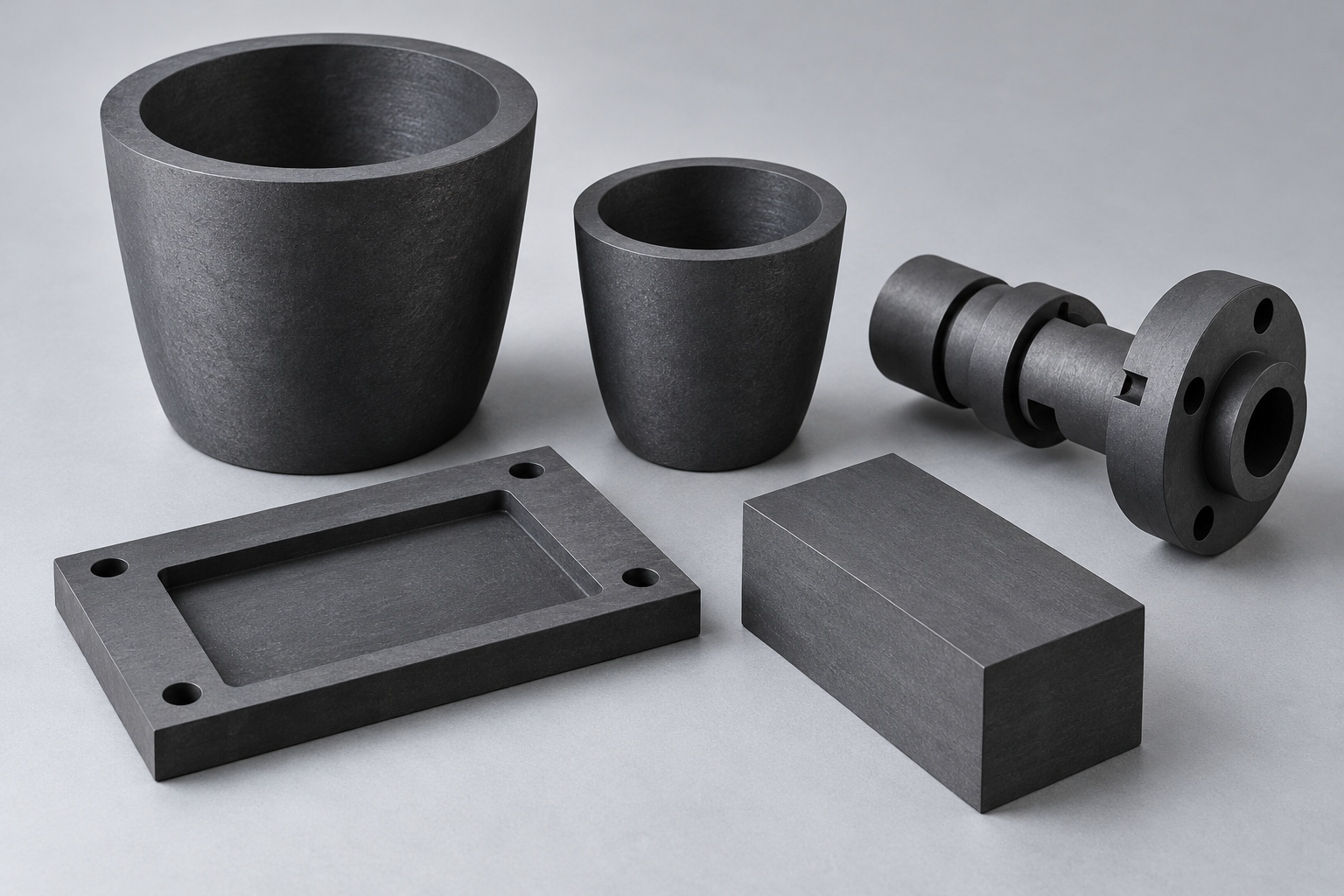
Precision CNC-turned fine-grain isostatic graphite crucibles with low ash content (<20–500 ppm) for non-ferrous, precious metal, alloy, and crystal-growth melting.
Alternate & search designations: High-purity isostatic graphite melting crucible, precious metal assay crucible, vacuum induction graphite pot
Purity / Grade Options99.9% (Ash <500 ppm) to 99.995% Purified (<20–50 ppm Ash)
Standard Dimensions5 mL lab cups to 50 kg induction melting crucibles
Available ConfigurationsCylindrical, spouted, induction-matched, lidded, pyrolytic/SiC coated
Ordering & MOQSpecification-based quote · Prototype & production lots
Material & Engineering Overview
Cold-isostatically pressed (CIP) fine-grain synthetic graphite combines isotropic thermal conductivity, complete immunity to thermal shock, natural molten-metal non-wetting (Au, Ag, Cu, Al, Sn, rare earths, brass), and increasing mechanical strength as temperature rises toward 2,500 °C in vacuum or inert atmospheres. Unlike clay-graphite foundry pots that introduce binder slag, pure machined isostatic graphite maintains clean melt chemistry.
Available in standard cylindrical, tapered, and pour-spout induction geometries or custom-turned from purified (<20–50 ppm ash) graphite billets with matching threaded or slip lids.
Standard Shipment Documentation: Manufacturer Graphite Grade COA (bulk density, open porosity, shore hardness, electrical resistivity, and ash ppm) plus dimensional check.
Primary Research & Industrial Applications
- Gold, silver, copper, and specialty non-ferrous induction & resistance melting
- Vacuum metallurgy, crystal growth (Bridgman / Czochralski susceptors), and distillation
- Pyrometallurgical fire assay, slag testing, and rare-earth fluoride reduction
- High-temperature salt and glass carbon-compatible processing
Nominal Material Reference Properties
| Property / Metric | Nominal Reference Value (Grade Dependent) |
|---|
| Bulk Density | 1.78–1.90 g/cm³ (isostatic fine-grain grades) |
| Average Grain Size | 5–15 µm |
| Ash Content | Standard <300–500 ppm; Halogen-purified <5–50 ppm |
| Max Service Temp | ~450–500 °C (Air onset of oxidation) / 2,800 °C (Inert Ar/N2) / 2,200 °C (Vacuum) |
| Flexural Strength | 45–75 MPa (increases ~25% at 2,000 °C) |
Reference values reflect typical sintered, fused, or wrought grades. Exact batch test figures are confirmed on your written quotation and accompanying lot Certificate of Analysis.
What to Specify in Your Quote Request
Specify crucible OD × ID × overall height × inner depth, melt alloy/material (avoid unprotected graphite for carbon-soluble Fe/Ni/Ti/Pt melts!), operating atmosphere, ash purity limit, lid style, and quantity.
Include target quantity, destination country/postal code for express air freight calculation, and any special cleanroom bagging or certification requests.
Prepare Graphite Crucibles RFQ ↗
Technical & Procurement FAQ
Which molten metals should NOT be melted directly in bare graphite crucibles?
Iron, steel, nickel, cobalt, titanium, zirconium, and platinum readily dissolve carbon to form carbides or eutectic melts; for those metals, choose alumina, YSZ zirconia, or h-BN crucibles (or use graphite solely as an outer induction susceptor around a ceramic liner).
When is halogen-purified (<20 ppm ash) graphite worth specifying?
Specify purified <20 ppm ash graphite for semiconductor crystal growth, solar/electronic silicon, optical fluorides, and 5N+ precious metal refining where trace Fe, V, or B from standard 300 ppm ash graphite cannot be tolerated.
How do I maximize graphite crucible life when pouring in open air?
Graphite begins oxidizing slowly in air above ~450–500 °C; use a close-fitting graphite lid, inert Ar/N2 cover gas shroud, or request an anti-oxidation surface impregnation/coating for air-exposure pours.
 TB-GR-CNC