Graphite Components · TB-PG-GC
Pyrolytic Graphite & Glassy (Vitreous) Carbon
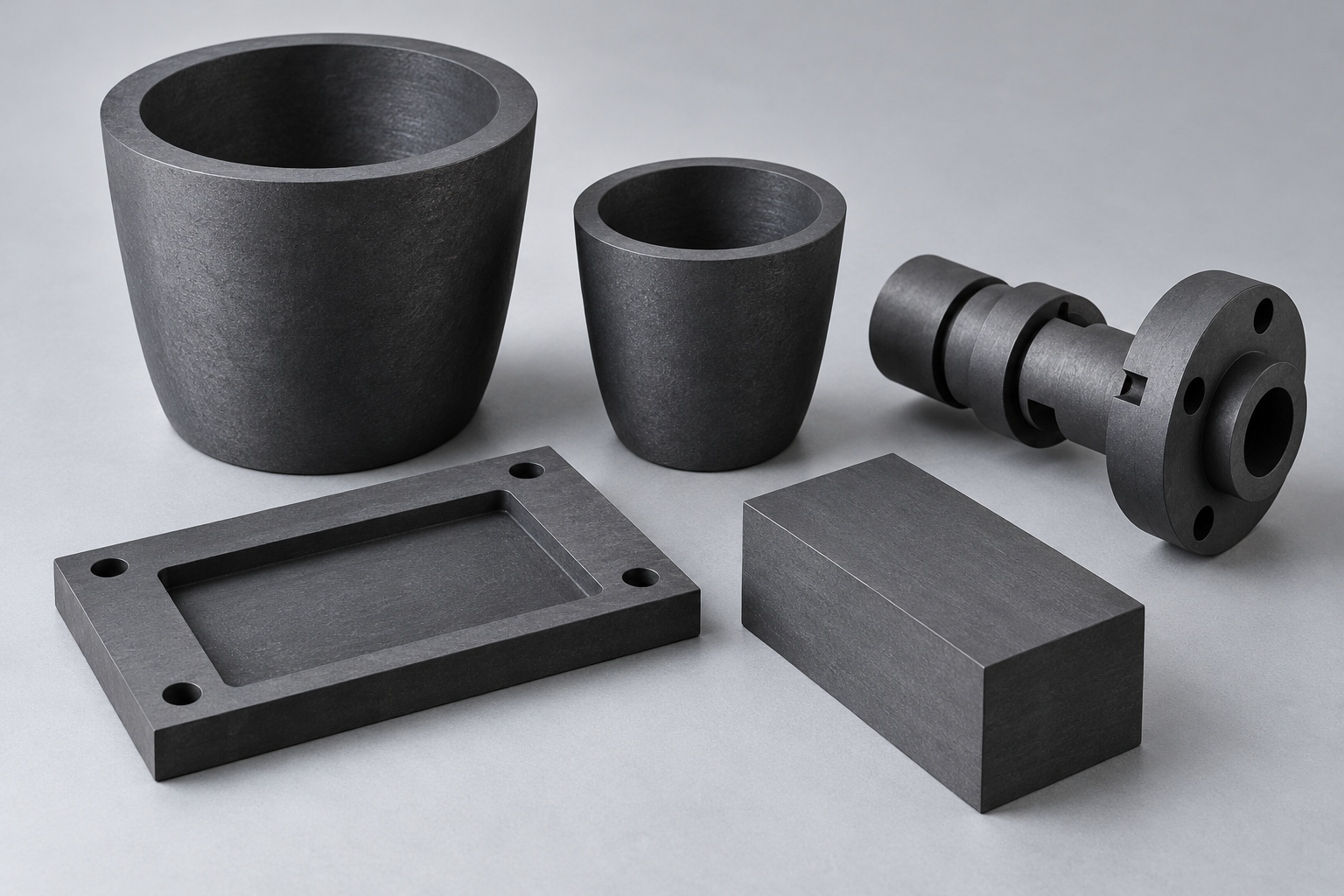
Ultra-pure 5N CVD pyrolytic graphite (anisotropic thermal/diamagnetic plates) and mirror-polished gas-impermeable glassy (vitreous) carbon electrodes, wafers, and crucibles.
Alternate & search designations: CVD pyrolytic graphite diamagnetic levitation plate, vitreous carbon RDE electrochemical electrode, HOPG substrate, gas-impermeable carbon crucible
Purity / Grade Options≥99.999% (5N CVD Pyrolytic Graphite & Polymeric Glassy Carbon)
Standard DimensionsPG plates 0.5–12 mm; Glassy carbon rods, plates, wafers, & crucibles
Available ConfigurationsAs-deposited PG, HOPG mosaic grades, Vitreous carbon plates/rods/crucibles
Ordering & MOQSpecification-based quote · Prototype & production lots
Material & Engineering Overview
Specialty non-porous carbons solve two problems isotropic sintered graphite cannot: CVD Pyrolytic Graphite (PG) possesses highly aligned graphene planes delivering massive in-plane thermal conductivity (~300–400 W/m·K) alongside perpendicular thermal insulation (~2–3 W/m·K) and strong room-temperature diamagnetism; meanwhile, Glassy (Vitreous) Carbon combines fullerene-like ribbon microstructure with zero open porosity, ceramic-like hardness, zero particle shedding, and wide electrochemical potential windows.
Supplied as pyrolytic graphite plates/discs/crucible coatings, and mirror-polished glassy carbon plates (1–6 mm), rotating-disk electrode (RDE) rods, and analytical fusion crucibles.
Standard Shipment Documentation: Manufacturer Lot COA (purity/ash ppm, density, resistivity, and dimensional/roughness check).
Primary Research & Industrial Applications
- Electrochemical working electrodes, RDE pins, and corrosion-free current collectors (Glassy Carbon)
- Trace analytical HF/HNO3 acid digestion & alkali fusion crucibles (Glassy Carbon)
- Anisotropic heat spreaders, X-ray/neutron optics, and passive diamagnetic levitation (Pyrolytic Graphite)
- Zero-particulate semiconductor e-beam evaporation liners and plasma etch rings
Nominal Material Reference Properties
| Property / Metric | Nominal Reference Value (Grade Dependent) |
|---|
| Purity | ≥99.995%–99.999% C (<5–20 ppm total ash) |
| Open Porosity / Gas Permeability | 0% open porosity; He permeability ~10⁻⁹ to 10⁻¹¹ cm²/s |
| Bulk Density | 2.18–2.22 g/cm³ (Pyrolytic Graphite) / 1.42–1.54 g/cm³ (Glassy Carbon) |
| Thermal Anisotropy (PG) | ab-plane ~350 W/m·K vs. c-axis ~2.5 W/m·K |
| Surface Polish (Glassy Carbon) | Mirror polish Ra < 10–25 nm available |
Reference values reflect typical sintered, fused, or wrought grades. Exact batch test figures are confirmed on your written quotation and accompanying lot Certificate of Analysis.
What to Specify in Your Quote Request
Specify Pyrolytic Graphite (anisotropic CVD carbon or HOPG mosaic angle ZYA/ZYB/ZYH) vs. Glassy/Vitreous Carbon (isotropic glassy mirror finish), form (plate, disc, rod, or crucible), dimensions, and surface finish.
Include target quantity, destination country/postal code for express air freight calculation, and any special cleanroom bagging or certification requests.
Prepare Pyrolytic Graphite & Glassy (Vitreous) Carbon RFQ ↗
Technical & Procurement FAQ
What is the key structural difference between pyrolytic graphite and glassy (vitreous) carbon?
Pyrolytic graphite is grown via high-temperature hydrocarbon CVD into highly ordered parallel graphene sheets (anisotropic, cleavable, strongly diamagnetic), whereas glassy carbon is pyrolyzed from thermosetting resin into an isotropic, amorphous ribbon network that fractures conchoidally like glass and takes a mirror polish.
Can glassy carbon plates withstand hydrofluoric acid (HF) and molten salts?
Yes—unlike quartz or ceramics, vitreous carbon is completely inert to hydrofluoric acid, non-oxidizing mineral acids, alkalis, and non-carburizing molten halide salts.
Which pyrolytic graphite orientation levitates passively over NdFeB permanent magnets?
Standard CVD pyrolytic graphite plates have their c-axis perpendicular to the plate face (ab-plane parallel to the face), producing maximum repulsive diamagnetic susceptibility perpendicular to the flat sheet.
 TB-PVD-LN