Thin Film Materials · TB-PVD-HFO2
Hafnium Dioxide (Hafnia) (HfO2) Sputtering Targets
High-density hot-pressed hafnium dioxide (hafnia) (HfO2, CAS 12055-23-1) ceramic sputtering targets in 4N (99.99% excl. Zr) / Low-Zr 4N purity, indium-bonded for arc-free RF and pulsed-DC thin-film deposition.
Alternate & search designations: Hafnium Dioxide (Hafnia) RF magnetron target, HfO2 PVD dielectric cathode disc, 4N HfO2 high-k gate & UV laser mirror sputtering target
Purity / Grade Options4N (99.99% excl. Zr) / Low-Zr 4N
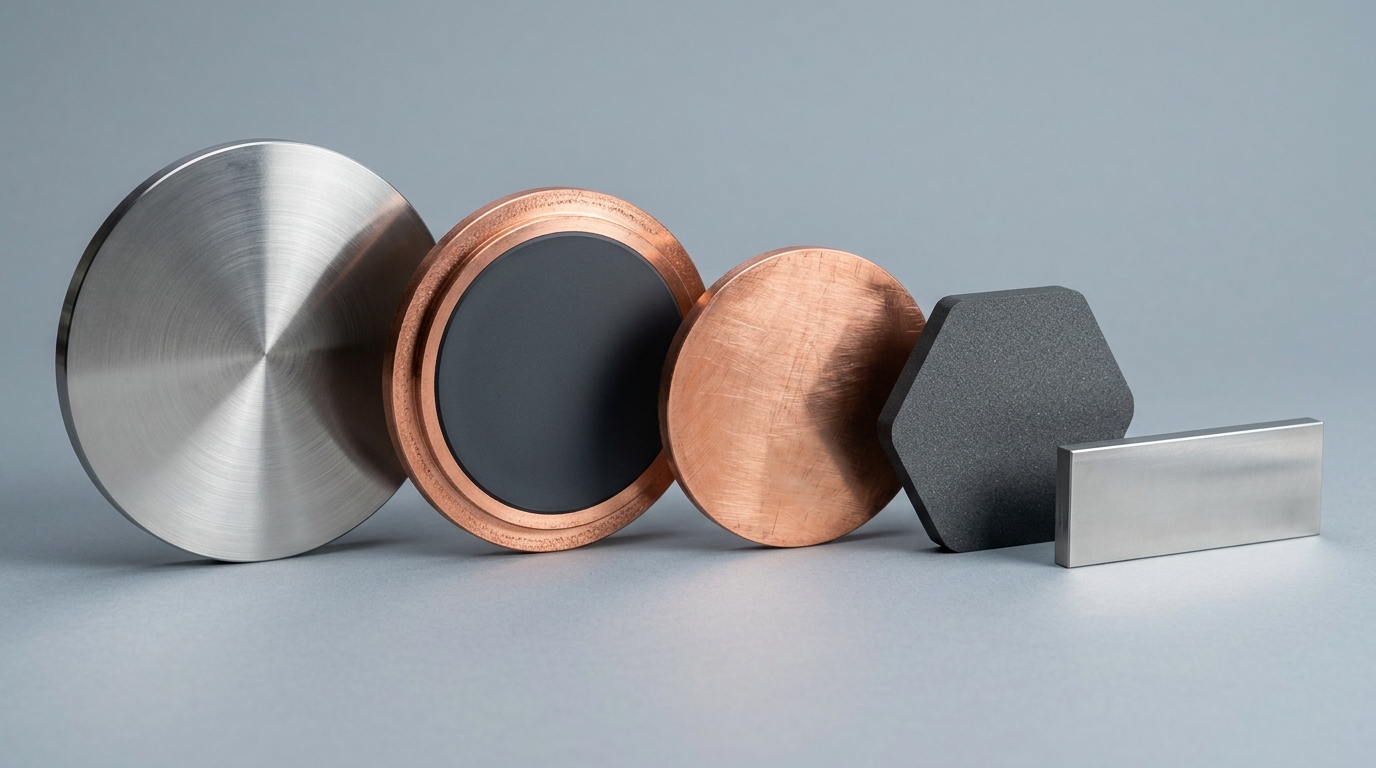
Standard DimensionsØ 1", 2", 3", 4", 6" × Thickness 2–6.35 mm (+ OFHC Cu Backing Plate)
Available ConfigurationsHot-pressed / HIP high-density ceramic disc; Metallic Indium bonded to OFHC Cu
Ordering & MOQSpecification-based quote · Prototype & production lots
Material & Engineering Overview
Sintered by vacuum hot-pressing or Hot Isostatic Pressing (HIP) from sub-micron 4N (99.99% excl. Zr) / Low-Zr 4N precursor powders, our hafnium dioxide (hafnia) (HfO2, CAS 12055-23-1) sputtering targets achieve high relative density (typically 96%–99.5% of 9.50 g/cm³ theoretical density) and homogeneous phase stoichiometry. High density suppresses outgassing, surface nodule formation, and plasma arcing during RF magnetron or reactive pulsed-DC sputtering.
Dense monoclinic/stabilized HfO2 targets combine wide bandgap (~5.7 eV, UV transparency to 220 nm) with high dielectric permittivity (εr ~ 20–25). Because ceramic targets have low thermal conductivity and limited thermal-shock resistance, we strongly recommend ordering HfO2 targets metallic-indium bonded to an OFHC copper backing plate. Each target ships vacuum-packed with its batch chemical assay and density COA.
Standard Shipment Documentation: Manufacturer Lot COA (stoichiometry, trace metal ICP assay in ppm, sintered bulk density) and backing-plate bond inspection.
Primary Research & Industrial Applications
- CMOS high-k MOSFET gate oxides and ferroelectric Zr/Si/Y-doped HfO2 FeRAM
- High-peak-power UV/excimer and femtosecond laser mirror coatings (n ~ 2.0)
- Memristive neuromorphic RRAM crossbar switching oxides
- Refractory corrosion and thermal barrier sensor coatings
Nominal Material Reference Properties
| Property / Metric | Nominal Reference Value (Grade Dependent) |
|---|
| Formula & CAS # | HfO2 (CAS 12055-23-1) |
| Purity Grades | 4N (99.99% excl. Zr) / Low-Zr 4N |
| Bulk / Theoretical Density | 9.50 g/cm³ (≥96%–99.5% relative density) |
| Recommended Bonding | Metallic Indium bond to OFHC Cu backing plate (<120 °C max run temp) |
| Recommended Power Ramp | RF / Pulsed-DC ramp at 5–10 W/min with ≥2–4 L/min cooling water |
Reference values reflect typical sintered, fused, or wrought grades. Exact batch test figures are confirmed on your written quotation and accompanying lot Certificate of Analysis.
What to Specify in Your Quote Request
Specify HfO2 purity (4N (99.99% excl. Zr) / Low-Zr 4N), exact dopant weight/mole ratio if applicable, ceramic disc diameter × thickness (e.g., Ø 50.8 × 3.175 mm), backing-plate geometry, and sputtering chamber gun model.
Include target quantity, destination country/postal code for express air freight calculation, and any special cleanroom bagging or certification requests.
Prepare Hafnium Dioxide (Hafnia) (HfO2) Sputtering Targets RFQ ↗
Technical & Procurement FAQ
Why should hafnium dioxide (hafnia) (HfO2) targets be indium-bonded to an OFHC copper backing plate?
As a brittle ceramic, HfO2 develops steep radial thermal gradients under RF plasma heating; full-coverage metallic indium bonding transfers heat efficiently into the water-cooled copper backing plate and prevents thermal-stress cracking.
What RF power conditioning procedure avoids cracking a new HfO2 target?
Start at low RF power (~15–25 W on a 2-inch target), ramp slowly at 5–10 W/min over 20–30 minutes while monitoring reflected power, and never exceed ~2–4 W/cm² power density on dielectric oxide/nitride targets.
Is oxygen or nitrogen reactive gas backfill needed when sputtering HfO2?
RF sputtering in pure argon often produces slightly anion-deficient films; introducing 1%–10% O2 (for oxides) or N2 (for nitrides) in the Ar plasma restores full stoichiometry and optical transparency.
 TB-PVD-OX