Thin Film Materials · TB-PVD-MT
Metal Sputtering Targets
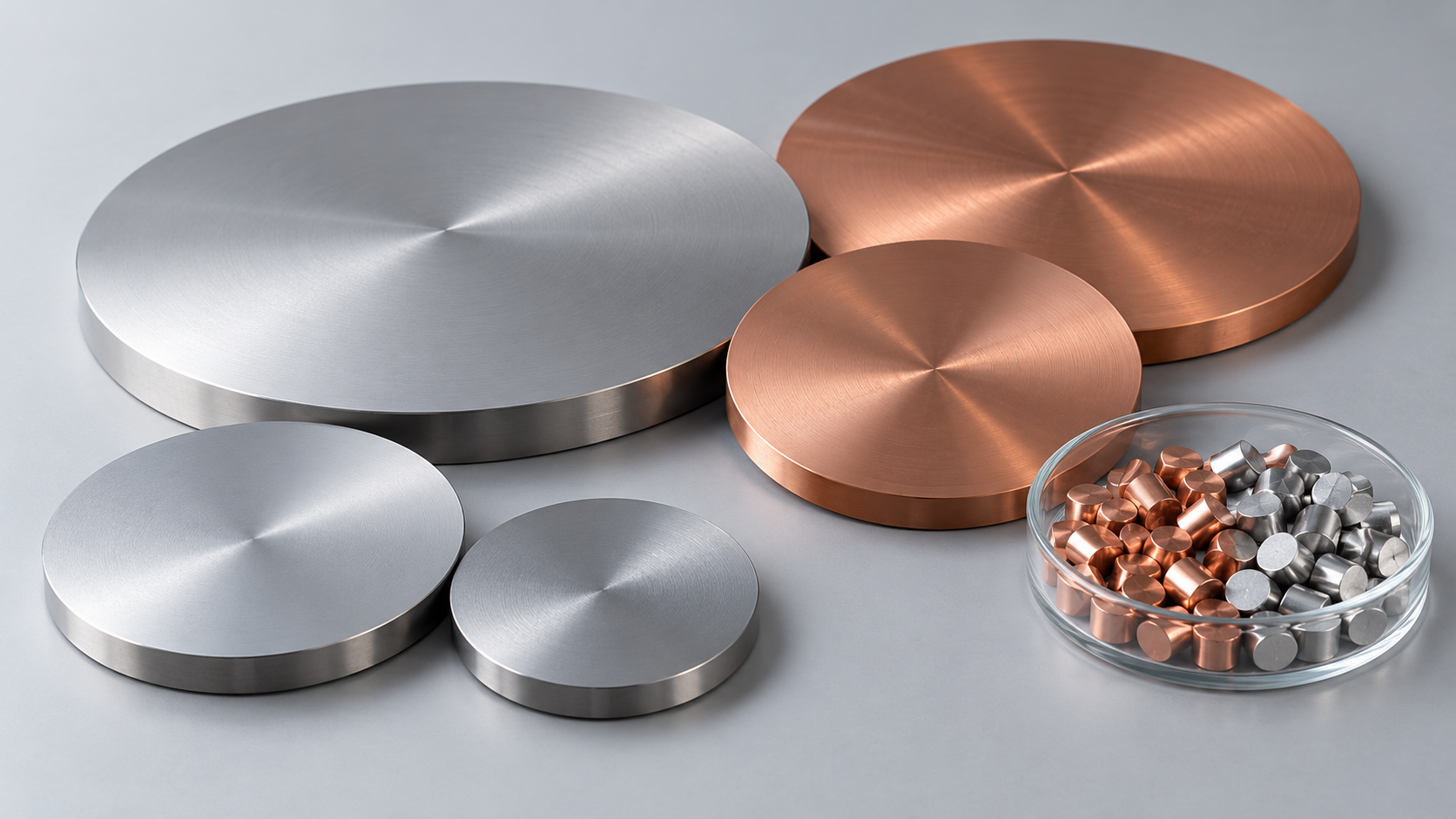
Vacuum-melted and thermomechanically forged pure metal and custom alloy planar sputtering targets (3N5–5N) sized for research and production magnetron cathodes.
Alternate & search designations: Magnetron PVD planar sputtering disc, 4N5 titanium/chromium/aluminum target, indium-bonded sputter cathode target
Purity / Grade Options3N5 (99.95%) / 4N (99.99%) / 4N5 / 5N (99.999%)
Standard DimensionsØ 1", 2", 3", 4", 6", 8" × Thickness 1–12.7 mm; Rectangular plates
Available ConfigurationsMonolithic, stepped flange, OFHC Cu/Mo backing plate + Indium/Elastomer bond
Ordering & MOQSpecification-based quote · Prototype & production lots
Material & Engineering Overview
Consistent thin-film sheet resistance, stress, and step coverage start with controlled target metallurgy: vacuum induction or electron-beam melted ingots thermomechanically rolled and recrystallized to fine, uniform grain sizes (<30–100 µm) with minimal trapped gas. We supply non-precious pure metals (Ti, Cr, Al, Cu, Ni, Co, Fe, V, W, Mo, Ta, Nb, Zr, Hf, Si, Ge, Sn, Bi, Zn) and binary/ternary alloys across 1-inch to 8-inch circular and rectangular cathode formats.
Targets are supplied monolithic or indium-/elastomer-bonded to OFHC copper or molybdenum backing plates, vacuum-sealed in argon/nitrogen barrier bags with lot GDMS or ICP-OES trace-element COA.
Standard Shipment Documentation: Manufacturer Lot COA (ICP-OES or GDMS trace metallic impurities in ppm), dimensional check, and ultrasonic bond verification when bonded.
Primary Research & Industrial Applications
- DC and RF magnetron PVD metallization, adhesion layers (Ti, Cr), and barrier films (Ta, TiW, WN)
- MEMS, photonic mirror coatings, and microelectronic wafer prototyping
- Magnetic thin-film stacks (NiFe, CoFeB, FePt; thin 0.5–2.0 mm high-permeability targets)
- Hard wear and decorative PVD nitride/carbide reactive sputtering
Nominal Material Reference Properties
| Property / Metric | Nominal Reference Value (Grade Dependent) |
|---|
| Purity Tiers | 99.95% (3N5), 99.99% (4N), 99.995% (4N5), 99.999% (5N) |
| Relative Density | ≥99.5%–100% wrought vacuum-melted density |
| Average Grain Size | Controlled fine equiaxed (<50–100 µm typical) |
| Standard Research Diameters | 25.4 mm (1"), 50.8 mm (2"), 76.2 mm (3"), 100/101.6 mm (4") |
| Bonding Options | Metallic Indium (>95% wet coverage) or High-Temp Silver Elastomer |
Reference values reflect typical sintered, fused, or wrought grades. Exact batch test figures are confirmed on your written quotation and accompanying lot Certificate of Analysis.
What to Specify in Your Quote Request
Specify element or atomic/weight-% alloy composition, purity (e.g., 4N vs. 5N), exact diameter and thickness (note thinner 1–2 mm requirement for ferromagnetic Ni/Fe/Co targets!), flat edge vs. stepped clamp lip, sputter gun model (Lesker Torus, AJA, Angstrom, Ulvac, Denton), and backing/bonding needs.
Include target quantity, destination country/postal code for express air freight calculation, and any special cleanroom bagging or certification requests.
Prepare Metal Sputtering Targets RFQ ↗
Technical & Procurement FAQ
Why do magnetic sputtering targets (Ni, Fe, Co) need thinner 1.0–2.0 mm thicknesses?
Ferromagnetic targets shunt the magnetron's permanent magnetic field internally if too thick, preventing plasma ignition; specifying 1.0–2.0 mm thickness allows magnetic flux pass-through on standard magnetron guns.
When is metallic indium bonding required on a metal sputtering target?
Ductile high-conductivity metals (Cu, Al, Ti) at moderate power often clamp monolithically, whereas brittle metals (Cr, Si, Ge, Bi, W), thin targets, or high-watt-density runs benefit from indium bonding to an OFHC copper backing plate for efficient water cooling.
How are reactive or oxidation-prone targets packaged?
Every target is solvent/DI cleaned, cleanroom dried, and vacuum-sealed (or argon back-filled) inside foil moisture-barrier bags with individual lot COA tags.
 TB-PVD-OX