Refractory Metals · TB-W-CMP
Pure Tungsten Crucibles, Rods, Sheets & Furnace Hardware
Ultra-high-melting-point (3,422 °C) 99.95%+ pure tungsten crucibles, centerless-ground rods, rolled sheets, wire, and hot-zone elements for extreme vacuum thermal systems.
Alternate & search designations: 99.95% pure wolfram sapphire-growth crucible, ground tungsten electrode & push rod, vacuum furnace tungsten mesh/plate heater
Purity / Grade Options≥99.95% W (3N5) & ≥99.99% W (4N); W-La2O3 / W-Re Alloys
Standard DimensionsRods Ø 0.5–80 mm, Foil/Sheet 0.05–15 mm, Sintered/Forged Crucibles
Available ConfigurationsPressed-sintered or forged-machined crucibles, ground rods, stress-relieved plates
Ordering & MOQSpecification-based quote · Prototype & production lots
Material & Engineering Overview
Boasting the highest melting point (3,422 °C) and lowest vapor pressure of all pure metals, tungsten is indispensable in vacuum/hydrogen/argon furnaces operating between 1,800 °C and 2,800 °C where molybdenum softens and graphite contaminates carbon-sensitive charges. Powder-metallurgy CIP-sintered and forged-machined tungsten crucibles contain molten sapphire (Al2O3 at 2,050+ °C), rare-earth metals, and refractory oxides without carbon vapor.
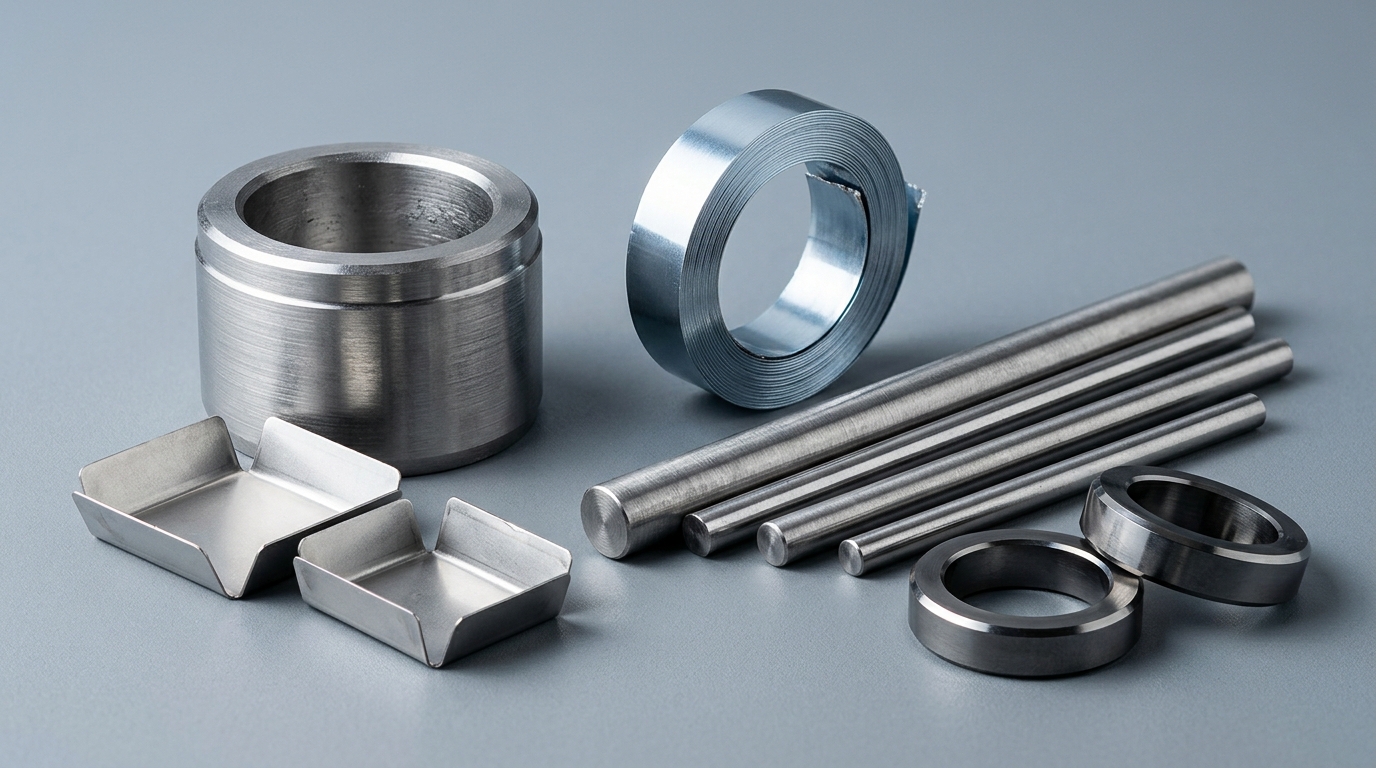
Available as thick-wall sintered/forged crucibles, spun thin-wall cups, centerless-ground rods, rolled stress-relieved foils and plates, twisted heating filaments, and lanthanated (WL10/WL20) machinable alloy forms.
Standard Shipment Documentation: Manufacturer Mill Lot COA (W %, trace Fe/Mo/Ni/C/O/N in ppm, bulk density, hardness) and dimensional inspection report.
Primary Research & Industrial Applications
- Sapphire crystal growth, rare-earth smelting, and quartz melting crucibles
- Ultra-high-temperature (>2,000 °C) carbon-free vacuum furnace heaters, racks, and shields
- Ion-implantation source chamber hardware, collimators, and X-ray/radiation shielding
- High-stiffness EDM/probe pins, TIG/plasma electrodes, and glass-melting electrodes
Nominal Material Reference Properties
| Property / Metric | Nominal Reference Value (Grade Dependent) |
|---|
| Tungsten Purity | ≥99.95% W (ASTM B760 / B777 class; 99.99% 4N on request) |
| Melting Point | 3,422 °C |
| Density | 18.2–18.8 g/cm³ (sintered crucible) / 19.1–19.25 g/cm³ (forged/wrought) |
| Thermal Expansion (CTE) | 4.5 × 10⁻⁶ /K (matches borosilicate/aluminosilicate glass seals) |
| Max Vacuum/Inert Service | 2,400–2,800 °C (oxidizes above ~400–500 °C in air) |
Reference values reflect typical sintered, fused, or wrought grades. Exact batch test figures are confirmed on your written quotation and accompanying lot Certificate of Analysis.
What to Specify in Your Quote Request
Specify product form (sintered machined crucible, spun cup, rod, foil/sheet, or custom hot-zone print), dimensions and tolerances, wrought forged vs. CIP-sintered density requirement, surface finish (black as-rolled vs. alkaline-cleaned/ground bright), and operating atmosphere.
Include target quantity, destination country/postal code for express air freight calculation, and any special cleanroom bagging or certification requests.
Prepare Pure Tungsten Crucibles, Rods, Sheets & Furnace Hardware RFQ ↗
Technical & Procurement FAQ
Should I choose a CIP-sintered or forged tungsten crucible?
CIP-sintered and CNC-turned crucibles (~18.3–18.6 g/cm³) are economical for larger wall thicknesses and general crystal/rare-earth melting, whereas forged/spun crucibles (≥19.0 g/cm³, refined grain) provide superior creep resistance and zero microporosity for repeated thermal cycles.
Why is lanthanated tungsten (W + 1% La2O3) sometimes chosen over pure tungsten for furnace parts?
Finely dispersed La2O3 particles raise tungsten's recrystallization temperature, reduce high-temperature sag/embrittlement, and noticeably improve CNC machinability.
Can tungsten hardware operate in nitrogen, hydrogen, or argon?
Yes—unlike titanium or tantalum (which embrittle in H2/N2), tungsten is compatible with ultra-pure hydrogen, argon, helium, nitrogen, and high vacuum.
 TB-MO-CMP