Technical Ceramics · TB-ZRO2-CR
Yttria-Stabilized Zirconia (YSZ) Ceramics
Transformation-toughened 3Y-TZP structural zirconia parts and ultra-refractory YSZ/Mg-PSZ crucibles, setter plates, and tubes rated up to 2,100 °C.
Alternate & search designations: TTZ toughened zirconia, 3Y-TZP structural ceramic, 8YSZ ultra-high-temperature crucible, zirconia oxygen sensor tube
Purity / Grade Options3Y-TZP (94.7% ZrO2) & 8Y-FSZ Refractory Grades
Standard DimensionsCrucibles 5–1,000 mL, tubes, setter plates, CNC rings
Available Configurations3 mol% Y2O3 structural tough grade; 5–8 mol% Y2O3 / MgO refractory grade
Ordering & MOQSpecification-based quote · Prototype & production lots
Material & Engineering Overview
Zirconium dioxide stabilized with yttria (3Y-TZP or 8YSZ) or magnesia (Mg-PSZ) bridges two demanding regimes: at room to moderate temperatures, fine-grain 3Y-TZP delivers the highest fracture toughness (~8–10 MPa·m½) and flexural strength (>900 MPa) of any oxide ceramic, outperforming alumina in impact and sliding wear; at extreme temperatures, fully stabilized YSZ crucibles and setter plates operate in oxidizing atmospheres up to 2,000–2,100 °C while resisting molten superalloys, platinum-group metals, and lithium-rich battery oxides.
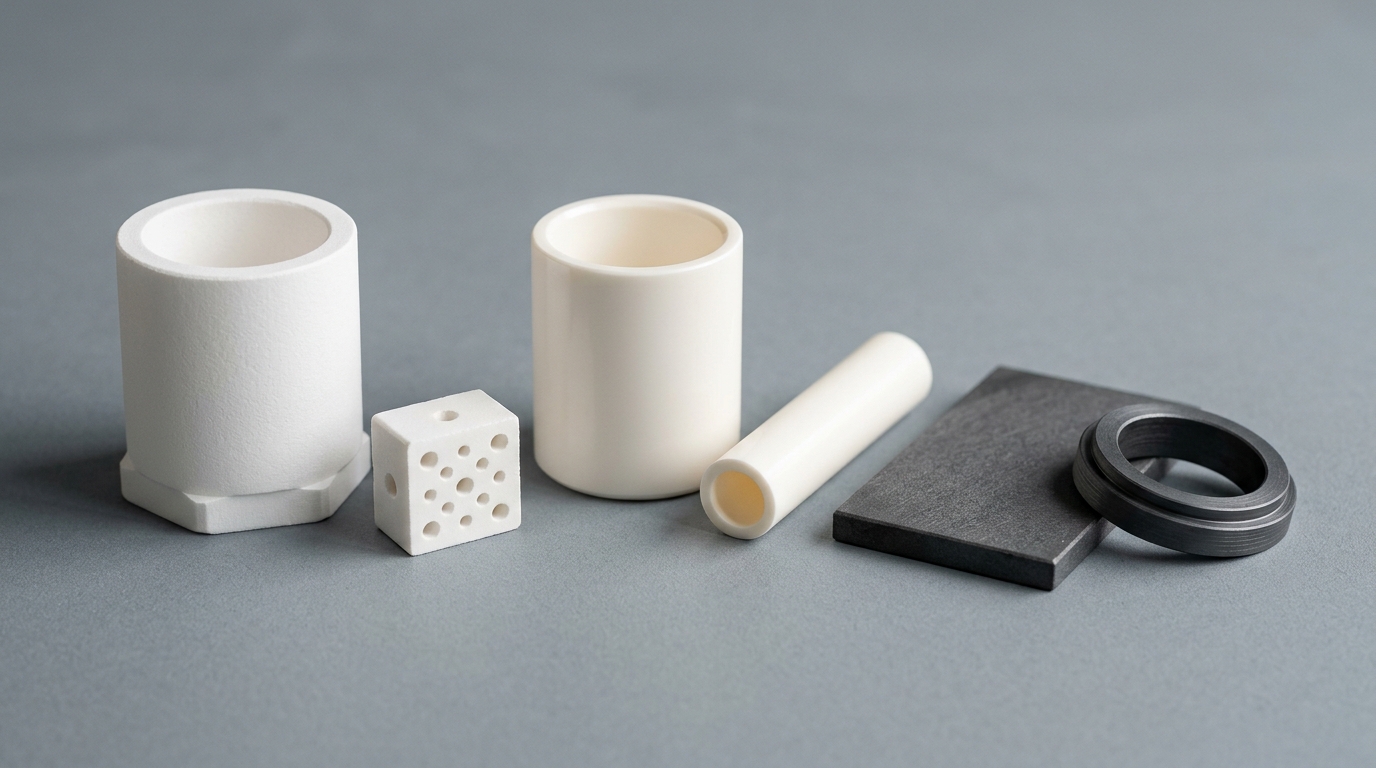
Supplied as crucibles, furnace tubes, calcination saggers, oxygen-ion solid-electrolyte discs, and precision ground wear rings.
Standard Shipment Documentation: Manufacturer Lot COA (ZrO2 + HfO2 %, Y2O3/MgO stabilizer %, bulk density) and dimensional inspection.
Primary Research & Industrial Applications
- Superalloy, platinum-group, and reactive melt crucibles up to 2,100 °C
- Lithium-rich solid-state battery (LLZO) calcination setter plates
- Solid oxide fuel cell (SOFC) / electrolyzer (SOEC) 8YSZ electrolyte membranes
- High-toughness wear sleeves, valve seats, shear blades, and guide rollers
Nominal Material Reference Properties
| Property / Metric | Nominal Reference Value (Grade Dependent) |
|---|
| Max Working Temp | 2,000–2,100 °C (8YSZ refractory) / <500–800 °C structural 3Y-TZP |
| Bulk Density | 5.95–6.08 g/cm³ (3Y-TZP) / 5.5–5.8 g/cm³ (refractory YSZ) |
| Flexural Strength (3Y-TZP) | 900–1,200 MPa |
| Thermal Conductivity | 2.0–2.5 W/m·K (exceptionally low thermal loss) |
| Fracture Toughness | 7.5–10 MPa·m½ |
Reference values reflect typical sintered, fused, or wrought grades. Exact batch test figures are confirmed on your written quotation and accompanying lot Certificate of Analysis.
What to Specify in Your Quote Request
Clarify whether your application is mechanical/wear (3 mol% Y2O3 fine-grain dense TZP) or ultra-high-temperature melting/calcining above 1,600 °C (8 mol% Y2O3 or CaO/MgO stabilized thermal-shock grade), along with geometry and heating rate.
Include target quantity, destination country/postal code for express air freight calculation, and any special cleanroom bagging or certification requests.
Prepare Yttria-Stabilized Zirconia (YSZ) Ceramics RFQ ↗
Technical & Procurement FAQ
What is the difference between 3Y-TZP and 8YSZ zirconia?
3Y-TZP (3 mol% yttria) is partially stabilized tetragonal zirconia engineered for maximum mechanical strength and toughness in structural parts, whereas 8YSZ (8 mol% yttria) is fully cubic stabilized to prevent phase-transformation cracking at temperatures up to 2,100 °C and to conduct O²⁻ ions.
Why must zirconia crucibles be heated more slowly than silicon carbide?
Zirconia has very low thermal conductivity (~2.2 W/m·K) combined with a relatively high CTE (~10 × 10⁻⁶ /K), so controlled ramp rates (typically ≤2–3 °C/min) prevent steep through-wall thermal stress.
Are YSZ setter plates suitable for LLZO garnet solid electrolyte sintering?
Yes—YSZ setter plates avoid aluminum contamination from Al2O3 plates when sintering Al-sensitive lithium lanthanum zirconium oxide (LLZO) pellets.
 TB-AL2O3-CR